Picture two versions of the same story. A woman in labor develops sudden, heavy bleeding. She recognizes it immediately as an emergency. Her family gets her to the nearest health facility within the hour. By every measure public health campaigns care about, she did everything right. In one version of this story, she survives, because the facility she reached had a trained attendant, the right medicine on hand, and a working referral line to a hospital. In the other version, she does not, because it did not. Same woman, same speed, same decision. The only thing that changed is the one variable she had no way of checking before she walked in.
Public health researchers have understood the difference between these two stories for three decades. In 1994, Sereen Thaddeus and Deborah Maine published a framework, still taught in maternal health programs worldwide, tracing preventable maternal deaths to three points of delay: delay in recognizing that something is wrong and deciding to seek care, delay in physically reaching a health facility once that decision is made, and delay in receiving adequate care after arrival. Most public health messaging in the Philippines focuses on the first two delays, urging women to recognize warning signs early and get to a facility quickly. That messaging saves lives, and it should continue. But it also has a blind spot: it treats arrival at a facility as the finish line, when for a portion of these deaths, arrival is only where the real risk begins.
The third delay is the only one of the three caused entirely by the system rather than the patient. It does not care how fast the tricycle got there or how quickly the family recognized the danger sign. A facility can be five minutes away, free of charge, and staffed around the clock, and still fail a mother if the blood bank is empty, if no one on shift that night is trained to manage a hemorrhage, or if the ambulance meant to carry her to a hospital that can help does not exist, or exists but has no fuel. When that happens, the story is not one of delay. It is one of readiness, and readiness is the delay nobody warns you about.
According to the Philippine Statistics Authority's official 2024 civil registration release, the country recorded 701,884 deaths that year across all causes, and among them, 1,852 were maternal deaths, women who died while pregnant or within 42 days of the pregnancy ending, from a cause related to the pregnancy itself.
CALABARZON's number is worth pausing on, because it is not just the highest maternal death count in the country. The same 2024 PSA release shows CALABARZON also recorded the highest number of infant deaths nationwide, 3,458 cases, and the highest number of fetal deaths, 1,727 cases. Three separate measures of the same underlying risk, all pointing to the same region. This is a region that includes Laguna, Cavite, Batangas, Rizal, and Quezon, generally well connected by road, within a few hours of Metro Manila's tertiary hospitals, and far from the geographic isolation that usually explains poor maternal outcomes elsewhere in the country. If distance and access were the whole story, CALABARZON should not be topping these tables. That it does suggests the deciding factor lies elsewhere, inside the facilities themselves.
The Philippines has historically tracked maternal mortality two different ways, through WHO modeled estimates and, more recently, directly from civil registration data. The Commission on Population and Development has publicly welcomed the shift toward civil-registration-based figures as a more accurate, more current picture, precisely because it lets national and local governments see where the gaps actually are rather than relying on a modeled national average.
Regionally, the picture is not only about raw counts, either. The same PSA release notes that Eastern Visayas was one of only three regions in the country where more registered deaths overall went unattended by a health care provider than attended, a different kind of gap, but one that speaks to the same underlying truth: whether a death is preventable often comes down to what happens, or does not happen, at the point of care.
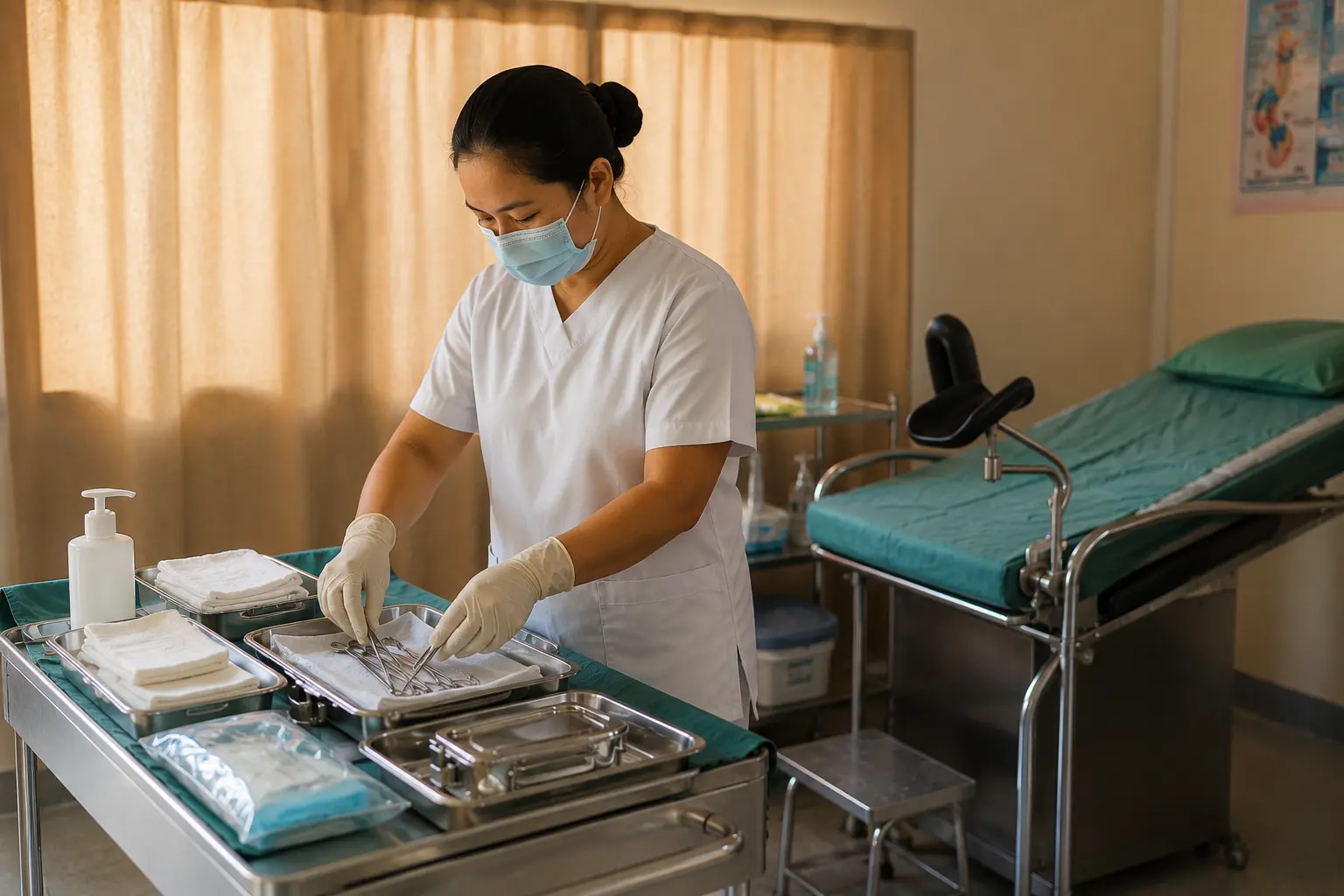
When public health practitioners talk about facility readiness, they are not describing a vague sense of preparedness. It is a specific, checkable set of conditions, and international frameworks such as the World Health Organization's Service Availability and Readiness Assessment and its Harmonized Health Facility Assessment break it down into concrete domains that can each be individually true or false on any given day, not just written down as true in a policy binder:
In the Philippines, this is reinforced by Department of Health standards for maternal and newborn care under Administrative Order 2012-0012 and Administrative Order 2020-0047, and it sits within the broader push for organized, tiered service delivery under the Universal Health Care Act of 2019, which asks facilities within a given area to function as a coordinated referral network rather than each operating in isolation. On paper, this is a coherent system. In practice, whether any single facility actually meets these standards on the day a mother needs it is a separate question entirely, and one that most facilities have never been asked to answer with evidence rather than assumption.
Most facilities and the local government units that oversee them are not being negligent when a readiness gap goes unnoticed. They simply have no standard way of finding out until it is too late to matter. A facility can go years assuming its equipment works and its referral line is solid, because the assumption is only ever tested during an actual emergency, at the exact moment there is no time left to fix it. That is the uncomfortable logic of the third delay: the worst possible moment to discover a gap in readiness is the only moment most facilities ever check.
Hemorrhage, hypertension, infection, and other medical complications remain the leading documented causes of maternal death in the Philippines. Every one of these has a known, manageable clinical response, provided the facility has the trained staff, the supplies, and the protocols in place at the exact moment they are needed, not most of the time, but every time.
Facility readiness assessment exists specifically to break that logic, by systematically checking each domain on a routine basis, on an ordinary Tuesday with no emergency in progress, rather than waiting to discover a gap through tragedy. It turns readiness from an assumption into a measured fact, one that can be tracked, compared, and improved before it is ever tested for real.
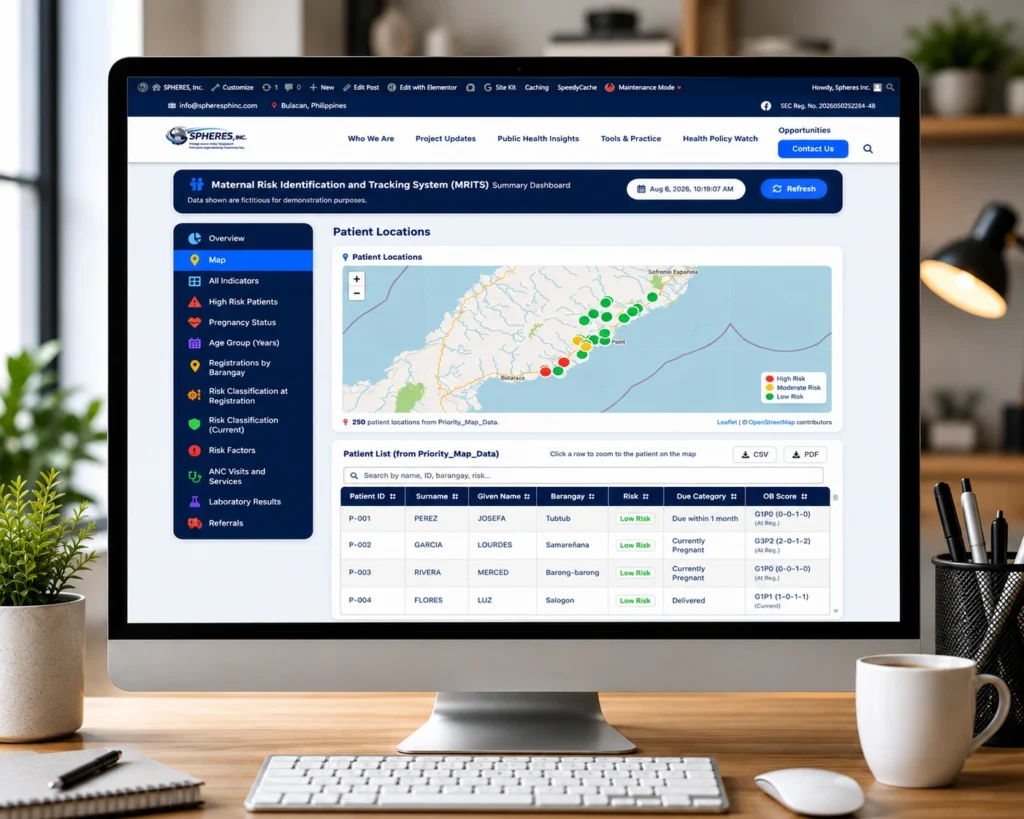
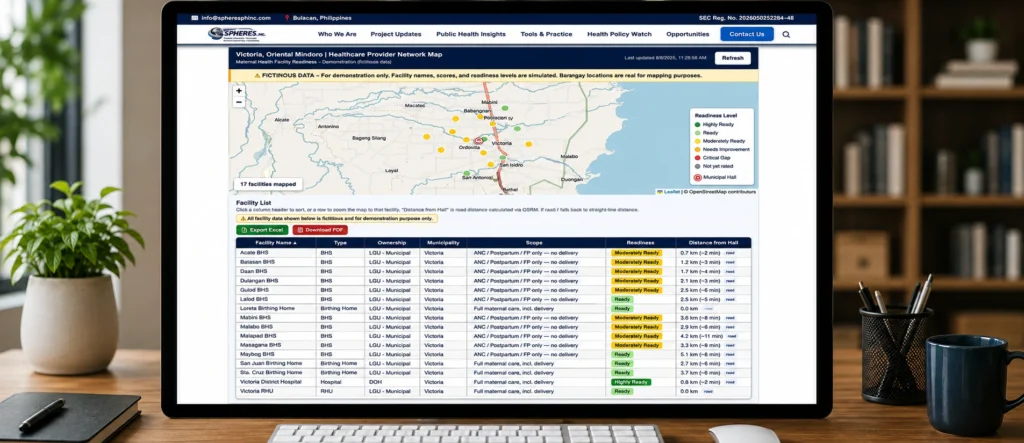
This is not only a theoretical exercise. The Municipality of Santa Cruz, in Laguna, part of the same CALABARZON region that topped the country's maternal, infant, and fetal death counts in 2024, has adopted a standardized Maternal Health Facility Readiness Self-Assessment Tool covering seven domains and over a hundred indicators tailored to each facility type in its area, from barangay health stations to hospitals. Rather than assuming readiness, facility teams complete a structured self-assessment grounded in the same Three Delays framework described above, and receive an instant readiness scorecard identifying exactly where gaps exist and what to do about them. Facility results are also plotted on a live map across Santa Cruz's Health Care Provider Network, so gaps become visible not just facility by facility, but across the entire referral pathway a mother might actually travel through on the worst day of her life.
Santa Cruz, Laguna adopted this self-assessment tool to support continuous quality improvement in maternal and newborn health services, turning individual facility results into a locality-wide planning resource for the Municipal Health Office.
Learn More About the Project →The value of this kind of self-assessment is not the scorecard itself. It is what the scorecard makes visible before it matters most: a facility can look at its results and see, in writing, exactly which of the seven domains needs attention, instead of finding out during an actual emergency that no one can act on in time. In a region that already leads the country in maternal, infant, and fetal deaths, that kind of advance warning is not a bureaucratic exercise. It is the difference between the two versions of the story at the top of this article.
For families, the honest takeaway is uncomfortable but important: not every facility that is reachable is equally ready, and that is not something a family can determine on their own by walking through the door. For local government units and facility administrators, the takeaway is more actionable, and considerably more hopeful. Readiness can be measured, tracked, and improved deliberately, the same way Santa Cruz has done, rather than discovered only when it is tested by an emergency that should have been survivable. The gap between the two versions of that opening story is not luck. It is a gap that can be closed, one facility, one domain, and one honest self-assessment at a time.