Postpartum hemorrhage (PPH) is the leading direct cause of maternal death worldwide, and it kills fast: a woman in hypovolemic shock can die within two hours without intervention. The non-pneumatic anti-shock garment, or NASG, is one of the few devices proven to buy that time cheaply, without electricity, without a specialist, and without a blood bank on site. It has been endorsed by WHO and FIGO since 2012, adopted in more than thirty countries, and studied extensively. What it has not done, in the Philippines specifically, is move past a single small trial in 2014. This piece lays out what the device actually does, what it actually costs to procure and train on, what has stopped other countries from scaling it, and what a realistic path to adoption looks like here.
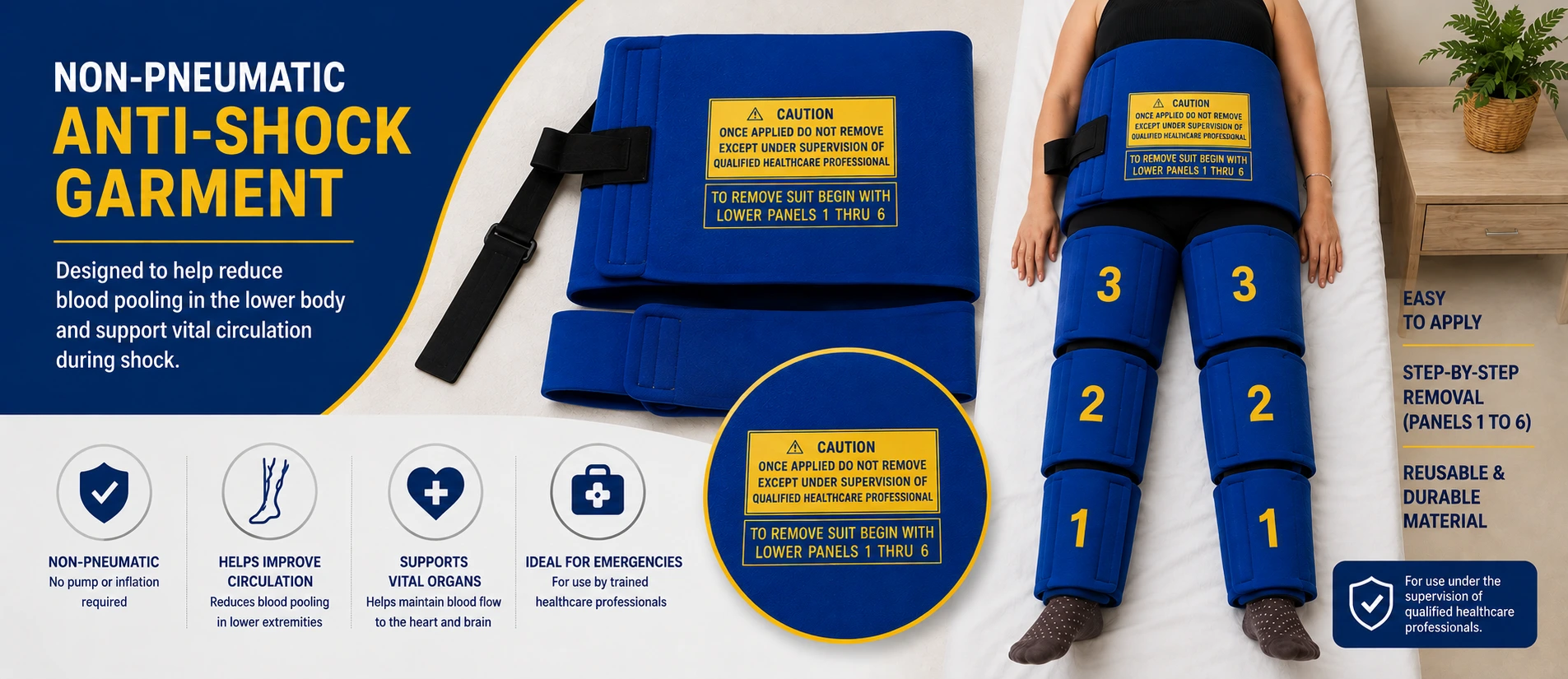
The NASG is a lightweight, washable, reusable compression device made of neoprene and secured with Velcro. It closes tightly around the legs, pelvis, and abdomen in five or six overlapping segments, with a foam compression ball positioned over the uterus for additional pressure. Once fastened, it applies 20 to 40 mmHg of circumferential counter-pressure to the lower body, well below the 70 mmHg ceiling that risks limb ischemia or compartment syndrome in the older pneumatic anti-shock trousers it replaced. That pressure pushes pooling blood out of the legs and abdomen and back toward the heart, lungs, and brain, buying a woman in shock time to reach definitive care. It does not treat the underlying cause of bleeding. It is, by design, a bridge, not a cure.
The World Health Organization (WHO) included the NASG as a temporizing measure in its 2012 recommendations for the prevention and treatment of postpartum hemorrhage and reaffirmed this in its 2020 guideline update. The International Federation of Gynecology and Obstetrics (FIGO) followed the same year and reaffirmed the recommendation again in its 2022 guidance on postpartum hemorrhage management. In 2015, WHO, the United Nations Children's Fund (UNICEF), and the United Nations Population Fund (UNFPA) jointly added the NASG to their interagency list of priority medical devices for maternal health, a listing that later research identified as one of the strongest single drivers of national uptake elsewhere.
The NASG was first used in a low-resource setting in Pakistan in 2002. By 2025, documented implementation existed across Ethiopia, India, Nigeria, Tanzania, Zimbabwe, Zambia, Mexico, Nepal, Colombia, Bangladesh, and Papua New Guinea, among others. The Philippines is not on that list, despite an early, undocumented trial in 2014.
The device has been studied since the early 2000s, including a cluster randomized controlled trial, several before-and-after implementation studies, and multiple systematic reviews. The results are consistent in direction, even where the exact magnitude varies by study design and setting:
That last figure is worth being precise about, since it circulates widely and is easy to misread. It comes from a 2025 systematic review and meta-analysis published in BMC Pregnancy and Childbirth, pooling eight studies and 2,690 healthcare providers in Ethiopia. It measures how often providers who had access to the NASG actually used it, not how well the device performs clinically when applied. The same review found that availability of the device at a facility multiplied the odds of use nearly eightfold, and that training multiplied it more than fivefold, findings that matter directly for how any rollout, including one in the Philippines, should be designed.
Cost is where most public discussion of the NASG goes vague. It shouldn't, because the real numbers are published and consistent across sources. Several of the figures below are expressed as cost per disability-adjusted life year (DALY) averted, the standard health economics unit for one lost year of healthy life, which lets very different interventions be compared on the same scale.
| Cost Item | Figure | Source |
|---|---|---|
| Unit price, bulk United Nations (UN) procurement | US$62.89 per garment (either size) | UNICEF Supply Division Long Term Arrangement, 2020 Technical Bulletin |
| Unit price, commonly cited | ~US$68 per garment | BMJ Global Health, 2025 |
| Unit price, early clinical trials | US$170 to US$295 per garment | Sutherland et al., cost-effectiveness analysis, 2013 |
| Reuse life | 40 to 144 uses per garment, depending on source and material generation | UNICEF; BMJ Global Health, 2025; VIA Global Health product listing |
| Cost per use after 2015 supplier agreement | Reduced from US$1.30 to under US$0.30, for public sector buyers in 51 countries | Clinton Health Access Initiative, 2015 |
| Net result, Egypt, severe shock | Cost-saving outright: net savings of US$9,489 per 1,000 women presenting in shock, mainly from reduced blood transfusions | Sutherland et al., PLOS ONE, 2013 |
| Cost-effectiveness, Nigeria, severe shock only | US$3.13 per DALY averted, far below the WHO threshold for a "very cost-effective" intervention | Sutherland et al., PLOS ONE, 2013 |
| Cost-effectiveness, Nigeria, all women in shock | US$4.13 per DALY averted, versus no NASG at all | Sutherland et al., PLOS ONE, 2013 |
| Cost-effectiveness, early application at primary health centers | US$21.78 per DALY averted, versus waiting until referral hospital level | Downing, El Ayadi, Miller et al., BMC Health Services Research, 2015 |
The pattern across every published analysis is the same: the device is either cost-saving outright, once averted blood transfusions and complications are counted, or so cheap per unit of health benefit that cost is not the limiting factor. The limiting factor, repeatedly, is procurement logistics and training, not the sticker price of the garment itself.
UNICEF's technical bulletin sets out order quantities by facility volume, useful for any Philippine facility or LGU budgeting for this:
| Facility Type | Recommended Stock |
|---|---|
| Dispensary or clinic, fewer than 1 birth/day, reliable ambulance access | 1 garment |
| Same, without reliable ambulance access | 2 garments, so one is always available while the other is in use |
| Facility with 1 to 5 deliveries/day | 2 garments, plus 1 extra for referral exchange |
| Facility with more than 10 deliveries/day (300+/month) | 3 garments, plus 1 extra for referral exchange |
| Referral hospital, more than 500 deliveries/month | 5 to 10 garments, plus 2 to 4 extra |
| Ambulances | 2 garments each, to allow exchange at pickup and drop-off |
Facilities or referral networks with a documented history of severe PPH cases should stock above these baseline figures.
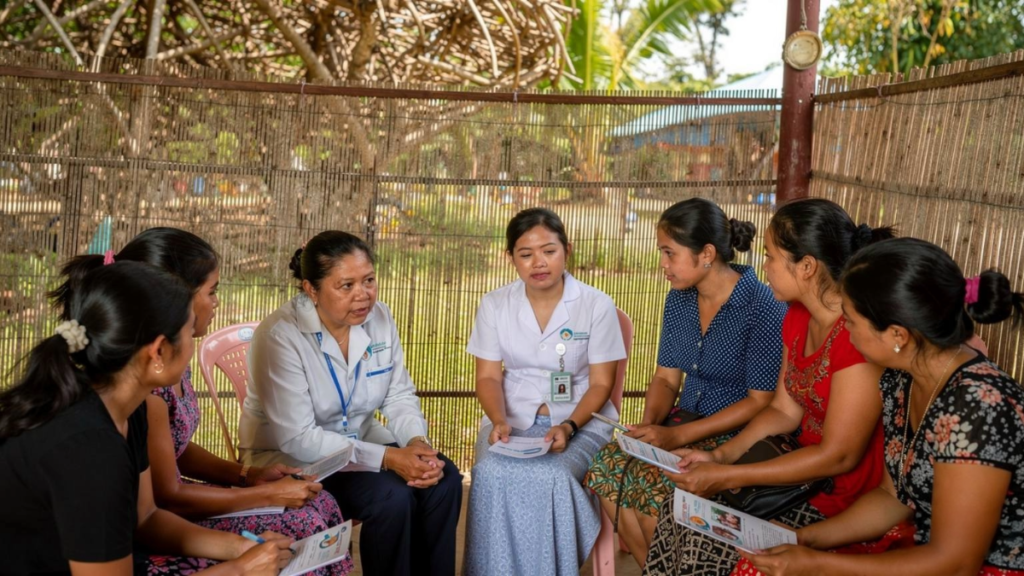
Because the NASG is low-technology, it does not require the multi-week certification pathways associated with surgical devices. The published literature is direct on this point: individuals at any level of the healthcare system, including community health workers, can be trained to apply the garment quickly and correctly. A rural Tanzania implementation reported strong results using mobile phone-based training videos and remote mentorship rather than in-person courses alone. In the 2025 Ethiopia meta-analysis, receiving formal training multiplied the odds of correct use more than fivefold, more than any other single factor measured.
Training alone is not sufficient. The largest systematic review of NASG scale-up barriers, published in BMJ Global Health in 2025, found that even well-trained providers could not sustain use where the device was not consistently in stock, where no facility protocol existed for when to apply it, or where senior clinicians were skeptical and had not endorsed its use. Training builds confidence; it does not substitute for supply chains, protocols, or institutional buy-in.
A 2025 systematic review in BMJ Global Health, mapping seventeen implementation studies across nine countries against a formal implementation science framework, found a consistent pattern of barriers and facilitators that any Philippine adoption plan should account for directly.
Yes, briefly. LifeWrap International, one of the main NASG suppliers, documented on its own site that a medical facility in the Philippines was trialling the LifeWrap NASG as of June 2014, after a patient with heavy postpartum bleeding recovered following its application. That single data point is the extent of the public record. The device does not appear in any of the country implementation lists tracked by the major 2025 systematic reviews, which cover Ethiopia, India, Nigeria, Pakistan, Tanzania, Zimbabwe, Zambia, Mexico, Nepal, Colombia, Bangladesh, and Papua New Guinea. In other words, the Philippines had an early, promising exposure to the device over a decade ago that was never scaled, documented, or institutionalized. That is arguably a better starting point than zero, since it means the device is not entirely unfamiliar, but it also means any current adoption effort is starting close to scratch.
The barriers-and-facilitators evidence points toward a specific kind of rollout: government-owned rather than NGO-parallel, bundled into training infrastructure that already exists, and targeted at facilities with a documented referral gap rather than distributed evenly and thinly. The Philippines already has most of the pieces this requires, just not yet connected to the NASG specifically.