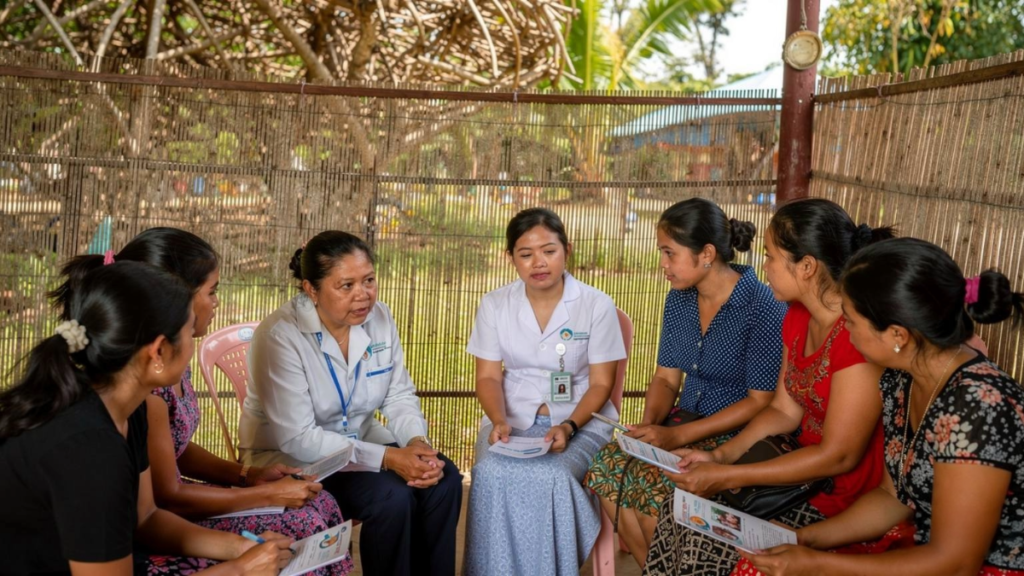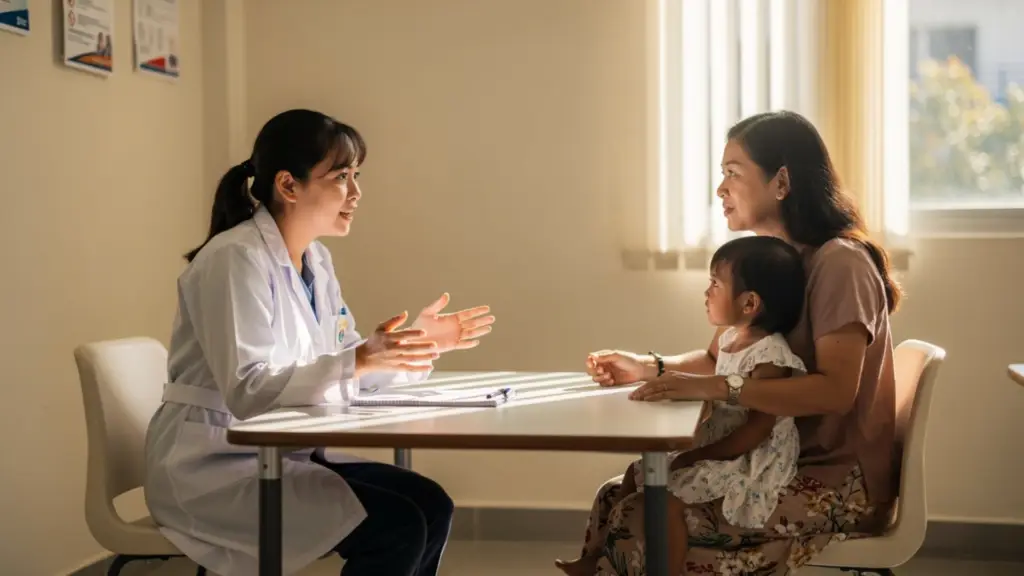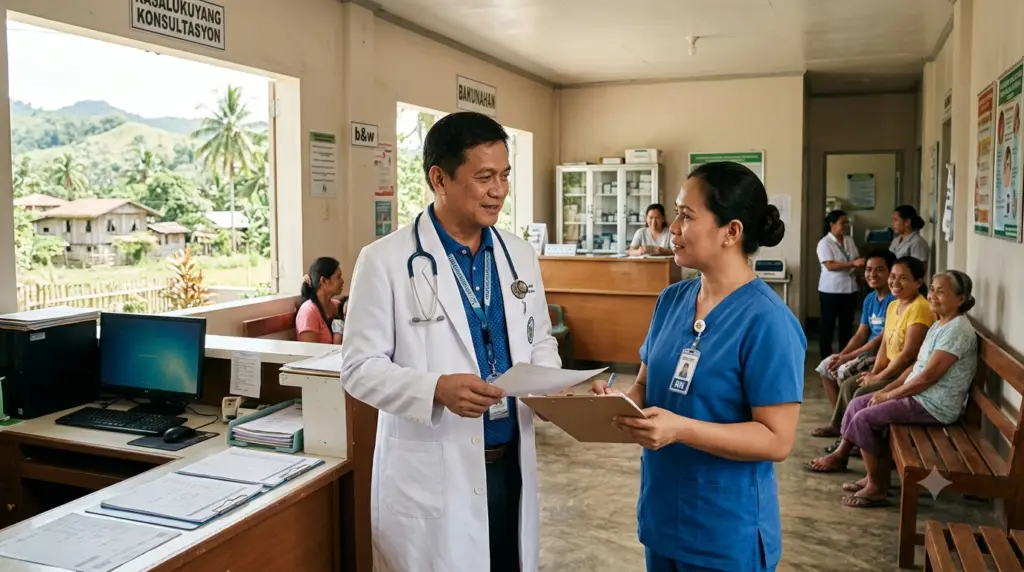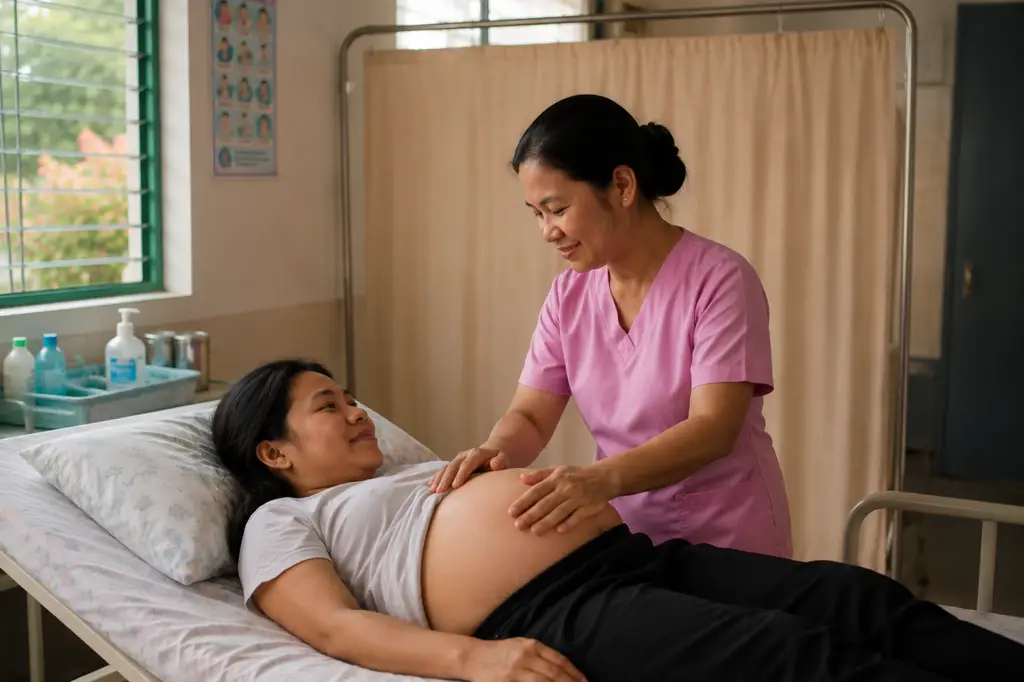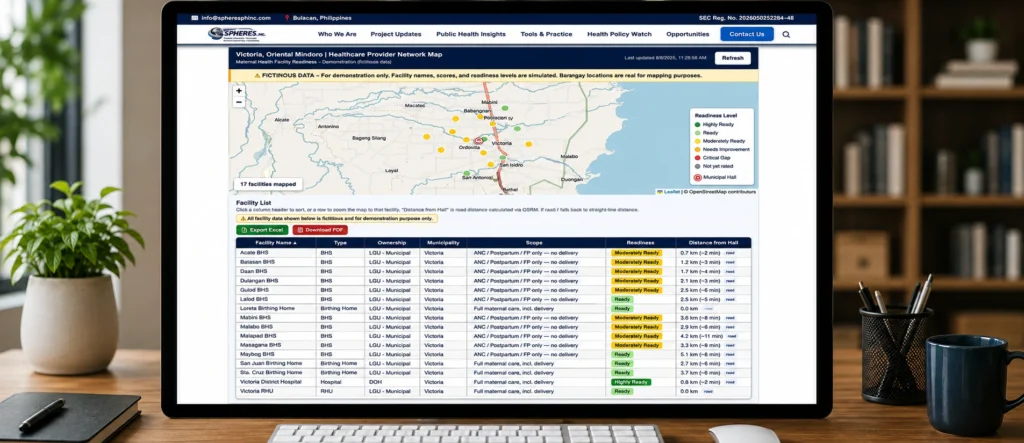
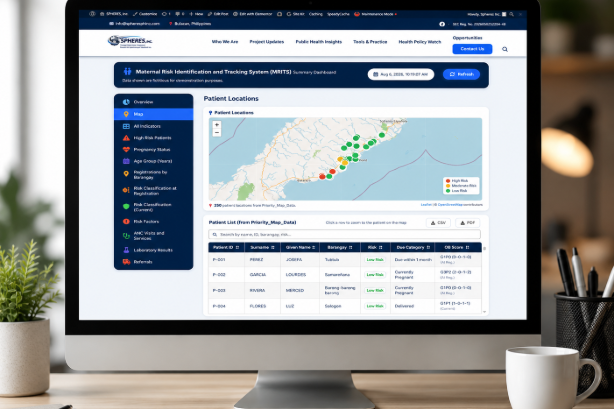
Most municipalities and cities still track the pregnant women in their catchment area the way they did twenty years ago: a paper logbook at the barangay health station, a risk assessment that lives in the memory of whichever barangay health worker did the home visit, and a referral that depends on someone remembering to make a phone call. When that BHW is on leave, or simply managing forty other households at once, a woman heading toward a difficult delivery can go unnoticed until it is an emergency. MaTRIS, the Maternal Tracking and Risk Identification System, is SPHERES, Inc.'s response to that gap: a lightweight digital system built around how barangay health workers actually work in the field, not around how a hospital information system assumes they work.
Community-based maternal risk screening is not a new idea. Barangay health workers have always been the first line of contact for pregnant women, especially in areas where the nearest facility is a jeepney ride away. What has been missing is a consistent, shared way to capture what a BHW already knows during that first home visit, so it does not disappear the moment she moves to the next household.
Paper-based tracking has three recurring failure points: a risk assessment that is only as good as whoever filled it out that day, a referral that depends entirely on personal follow-up rather than a system that flags it, and a supervisor at the municipal or city health office who has no way to see the overall picture without physically collecting and re-tallying every barangay's logbook. MaTRIS addresses all three by giving BHWs a structured, mobile-friendly way to register, classify, and follow a woman from her first prenatal contact through delivery and postnatal care, with everything visible on a single live dashboard for whoever is supervising the program.
The point of MaTRIS is clinical action, not data collection. Registration, antenatal logging, and dashboard monitoring are the means by which the time between identifying a woman at risk and acting on it gets shorter, not ends in themselves. It is not a registry of pregnant women. It is a way of acting on the ones who need care most urgently.
At its core, MaTRIS covers four things a maternal health program needs to do well, in one connected system rather than four separate processes:
A single case moving through MaTRIS looks like this:
A tool built for a hospital records department does not automatically work for a barangay health station, and a lot of digital health tools fail in the field for exactly that reason. MaTRIS was designed around three constraints that actually shape how BHWs work:
The dashboard is built for the people supervising the program, not just the BHWs collecting the data. At a glance, it shows the total number of women currently being followed, a breakdown by risk level, how many have delivered and what the outcomes were, and an interactive map of where every registered woman is located, color-coded by risk. Sections can be filtered by barangay, so a supervisor reviewing one area does not have to wade through the whole LGU's data to do it.
In an actual deployment, the dashboard is secured behind a login page. Only authorised health office staff with valid credentials can access it.
The data shown in the demo is fictitious and generated for illustration only. It does not represent real Clients or an active deployment.
The demo link above is public specifically because it contains no real Client information. In an actual deployment, the dashboard is not publicly viewable: access is granted only to authorized program staff, such as supervising midwives, nurses, and health office personnel, not to the general public or to anyone with the link. Client-level data, names, addresses, and health information, is only ever visible to people the LGU has specifically authorized to see it.
While the supervisor dashboard gives program managers a high‑level view, the BHW herself needs to see her own Clients — right now, while she is in the field. MaTRIS now includes a dedicated BHW Client Viewer, a mobile‑friendly web page that gives every barangay health worker instant access to the list of pregnant women she is responsible for, wherever she has her phone.
The page is designed for intermittent connectivity and low‑bandwidth conditions: it loads quickly, uses minimal data, and can be refreshed with one tap. The BHW’s name and barangay are saved on her phone, so she never has to re‑enter them. A PIN‑protected settings button prevents unauthorized changes to the barangay assignment — important when phones are sometimes shared.
In a real deployment, the viewer is protected by two security layers. First, a login page guards access to the viewer site, so only authorised users can reach it. Second, after login the BHW must enter a barangay‑specific PIN. Each barangay has its own PIN, shared by all BHWs assigned to that area, ensuring that a health worker can only view the caseload of her own barangay. Without the correct PIN, no patient data is displayed.
Because the viewer pulls data directly from the same data pipeline that feeds the dashboard, the BHW sees the same live information that the midwife or municipal health officer sees. If a new registration is added, a risk level changes, or a delivery is recorded, it appears on the BHW’s phone the next time she refreshes.
The Clients shown in the demo are fictitious. In a real deployment, the BHW viewer is secured with a login and a barangay‑specific PIN, and only shows women from the barangay that the health worker is assigned to, and only to authorized program staff.
The BHW Client Viewer gives each barangay health worker visibility into her own caseload. RHU midwives, nurses, and doctors need something different: when a woman arrives for a follow‑up visit, or a referral needs to be resolved, they need her complete history in front of them, not just a caseload list. MaTRIS now includes a dedicated RHU Maternal Client Lookup, a search‑by‑name‑or‑ID tool built specifically for RHU clinical staff, giving instant access to a woman’s full obstetric, risk, and referral history at the point of care.
Because the lookup reads from the same live data pipeline that feeds the supervisor dashboard and the BHW Client Viewer, RHU staff always see the same up‑to‑date information, refreshed at every import.
Important note about security: The records shown in the demo are fictitious. In a real deployment, the RHU Maternal Client Lookup requires a login before any patient data is displayed, and access is granted individually and only to authorized RHU midwives, nurses, and doctors. Anyone without an authorized account cannot open the page at all.
Maternal health records are sensitive by nature, and any LGU evaluating a digital tracking tool is right to ask who can actually see the data before agreeing to use it. MaTRIS is built around a simple principle: access is granted, not open. Every dashboard is set up specifically for the municipality or city using it, with viewing access limited to the people the LGU designates, typically the supervising health office staff and program coordinators. Field-level data collected by BHWs is likewise only accessible to the program, not published or shared externally.
In an actual deployment, both the supervisor dashboard and the BHW Client Viewer require authentication before any patient data is displayed. The dashboard is secured by a user login. The BHW viewer adds a second layer: after the initial login, a barangay‑specific PIN must be entered to unlock the patient list. This two‑step approach keeps the viewer accessible to multiple BHWs in the same barangay while preventing unauthorised access from anyone without the PIN.
The RHU Maternal Client Lookup uses a simpler, single-layer model: it requires its own authenticated login before it will display any patient data, and access is granted individually to RHU midwives, nurses, and doctors. Anyone without an authorized account cannot open the page at all. Because the tool searches across the whole catchment area rather than a single barangay, it does not use a barangay‑specific PIN the way the BHW Client Viewer does; the login itself, restricted to a named list of authorized RHU staff, is the access control.
This is also why the public demos linked above exist at all: it is only possible to make them openly viewable because every record in them is fictitious. A real deployment, with real Clients, is never set up that way.
| Paper-Based Tracking | MaTRIS | |
|---|---|---|
| Risk classification | Depends on the individual BHW's judgment that day | Classified consistently from the information recorded |
| Referral follow-up | Relies on someone remembering to call or follow up | A clear action card tells the BHW what to do, rather than depending on memory |
| Program-level visibility | Requires manually collecting and re-tallying every barangay's logbook | Updates live on a single dashboard as records are entered |
| Where the data lives | Scattered across separate forms and notebooks | One record per woman, from registration through postnatal care |
| Locating priority cases | Not mapped; requires cross-referencing addresses by hand | Shown on an interactive, barangay-level map |
Cost is usually one of the first questions an LGU asks about any new digital system, and it is a fair one. MaTRIS was intentionally built on readily available, cost-effective technology rather than expensive, purpose-built infrastructure, specifically to keep this from becoming a barrier to adoption.
Most municipalities and cities already have what the system actually needs at the point of use: smartphones or tablets for BHWs in the field, and computers with internet access at the health office for supervisors reviewing the dashboard. Because of that, implementation cost is driven mainly by deployment, configuration to the LGU's own barangay structure, and training, not by software licensing or specialized hardware.
The exact cost depends on the size of the LGU and the number of users, since a larger municipality or city with more barangays and more BHWs naturally takes more configuration and training to roll out. SPHERES, Inc. can walk through what that looks like for your specific LGU during an initial conversation.
MaTRIS is built to fit into an existing BHW-led program rather than replace it. LGUs considering it, whether a municipality or a city, generally already have most of what is needed in place:
SPHERES, Inc. works directly with the LGU to configure MaTRIS around its actual barangay structure, existing risk criteria, and referral pathway, so it complements the program already in place rather than asking a health office to redesign its workflow around the software.
MaTRIS was designed to be configurable to any LGU’s structure and protocols, and one clear example of that adaptability is the Buntis Partner Program in Santa Cruz, Laguna. This community-based maternal health initiative has adopted and customized MaTRIS as its digital tracking and risk identification platform, tailoring it precisely to the municipality’s local context.
In this deployment, the system was aligned with Santa Cruz’s existing maternal health workflow, including its own risk classification guidelines, referral pathways to rural health units and hospitals, and the specific barangay network of the municipality. Barangay health workers use MaTRIS to register pregnant women during home visits, conduct risk screening, and receive clear action cards that guide them through the next steps for moderate- and high-risk cases. Supervisors at the municipal health office monitor the entire program through the live dashboard, which maps cases by barangay and highlights women who need urgent follow-up.
Program Page
Learn more about the Buntis Partner Program and its use of MaTRIS in Santa Cruz, Laguna:
Buntis Partner Program – Sta. Cruz, Laguna
The Santa Cruz deployment shows how MaTRIS can be adapted to fit a specific local program — not just as a generic tracking tool, but as a fully integrated part of a municipality’s maternal health strategy.
Want MaTRIS in Your Municipality or City?
SPHERES, Inc. works directly with local government units to configure and deploy MaTRIS for community-based maternal risk tracking. We also partner with funding agencies, NGOs, and development organizations supporting maternal health initiatives who are interested in bringing this system to the communities they serve. If that's you, whether an LGU, a funder, or an implementing partner, we would like to hear from you.
Get in Touch