
Two acronyms that differ by a single letter, the Maternal and Neonatal Death Reporting System (MNDRS) and Maternal and Neonatal Death Surveillance and Response (MNDSR), cause real confusion among local health office staff and facility teams in the Philippines. They are not competing systems and they are not the same thing. One captures the fact that a death happened. The other exists to figure out why it happened and to make sure something changes as a result. This guide explains what each system actually does, walks through how a real case moves between them, and covers what a facility needs in place for both.
The Maternal and Neonatal Death Reporting System is the Department of Health's reporting mechanism for maternal, neonatal, and infant deaths, developed in collaboration with the World Health Organization Philippines. Republic Act 10354, the Responsible Parenthood and Reproductive Health Act, made regular maternal, fetal, and infant death reviews a legal requirement for health facilities, and MNDRS is the operational channel that facilities use to meet that requirement.
Maternal and Neonatal Death Surveillance and Response is the review and action side. The Department of Health has required some form of maternal and perinatal death review since at least 2000, coordinating with the Philippine Obstetrical and Gynecological Society, the Philippine Society for Newborn Medicine, and the Perinatal Association of the Philippines on Maternal Death Review and Perinatal Death Review protocols. MNDSR is the more structured, internationally standardized version of that same idea, adapted from the World Health Organization's Maternal and Perinatal Death Surveillance and Response approach, known globally as MPDSR. According to UNFPA Philippines, essential guidelines for MNDSR were developed in partnership with WHO as part of results achieved in 2024, specifically to strengthen health systems through improved data collection.
doh.gov.ph, National Safe Motherhood Program, the parent program under which maternal death reporting and review sits
unfpa.org, Philippines transparency portal, confirming the MNDSR essential guidelines developed with WHO
According to the Professional Regulation Commission's continuing professional development platform, which listed a DOH Center for Health Development Caraga training on MNDRS held in Butuan City on October 23 and 24, 2025, the system is described as a reporting mechanism that utilizes internet and SMS technology to enable real time notification, validation, review, and response to maternal, neonatal, and infant deaths. That same description notes the tool triggers alerts to concerned health workers, prompts validation of reports, and generates reports at all levels, from local health facilities up to the national level.
Rollout has continued into 2026. The DOH Eastern Visayas Center for Health Development ran a three day Training on Maternal Neonatal Death Surveillance and Response from July 29 to 31, 2026, at the Costa Brava Hotel in Tacloban, Leyte, organized jointly with the Provincial Health Offices, the Provincial District Offices, the World Health Organization, UNICEF, and the Philippine Society for Responsible Parenthood (PSRP) as a technical resource organization. The program covered MNDRS and MNDSR together on the first day, followed by dedicated sessions on the Three Delays Model, the Six Step Audit Cycle, fishbone analysis for root cause review, and simulation exercises using actual maternal death review forms.
In practical terms, that means MNDRS does three things:
Reporting itself starts at the community or facility level, where a midwife or designated health worker completes a death reporting form. The report then moves through validation at the municipal or city health office and on to the provincial and regional level, consistent with the DOH's longstanding practice of conducting maternal death reporting and review in collaboration with Provincial and City Review Teams.
A note on reachability: several older references describe MNDRS as accessible through a dedicated web portal. At the time this article was written, that portal could not be confirmed as reachable. Facilities should confirm the current reporting channel with their Center for Health Development rather than relying on any specific URL found online.
Before sitting in on a review or a reporting orientation, these terms come up constantly and are easy to mix up:
| Term | What It Means |
|---|---|
| MHO / CHO | Municipal Health Officer or City Health Officer, the first point of validation for a reported death |
| CHD | Center for Health Development, the DOH's regional office, which oversees and consolidates cases in its region |
| MPDSR | Maternal and Perinatal Death Surveillance and Response, the WHO global framework MNDSR is adapted from |
| MNIDRS | Alternate name used for MNDRS when infant deaths, not just maternal and neonatal, are included in scope |
| Three Delays Model | A framework tracing a death to delay in seeking care, reaching a facility, or receiving adequate care |
Where MNDRS asks what happened and how many, MNDSR asks why it happened and what needs to change. A multidisciplinary death review committee examines each validated case using a methodology built around three core concepts.
A 2022 assessment published in the International Journal of Gynecology and Obstetrics found that MNDSR was implemented in Burundi but still needed stronger follow-through on the response and monitoring steps, a common gap even in countries further along in rollout than the Philippines. Completing a review meeting is not the same as completing the cycle.
In practice, Philippine MNDSR trainings also teach fishbone analysis, a root cause diagramming technique that maps the chain of contributing factors behind a single death across categories such as facility readiness, referral systems, and community-level delays. It is used alongside the Three Delays Model rather than in place of it, giving committees a second, more visual way to trace a case back to a specific, fixable gap before the Six Step Audit Cycle moves into recommendation and response.
An illustrative example makes the handoff between the two systems concrete.
| MNDRS | MNDSR | |
|---|---|---|
| Primary function | Reporting and data capture | Review, root cause analysis, and response |
| Core question | What happened, and how many cases | Why it happened, and what needs to change |
| Main output | A validated death report and statistical trends | An action plan targeting a specific system gap |
| Key mechanism | Alerts, validation, and reporting up the chain from facility to CHD | No Name No Blame review, Three Delays Model, Six-Step Audit Cycle |
| Who is mainly involved | Midwives, facility reporters, MHO or CHO validators | Multidisciplinary death review committee, facility and LGU leadership |
| Legal or policy basis | RA 10354, Section 8; DOH and WHO Philippines collaboration | WHO MPDSR framework, adapted nationally with UNFPA and WHO support |
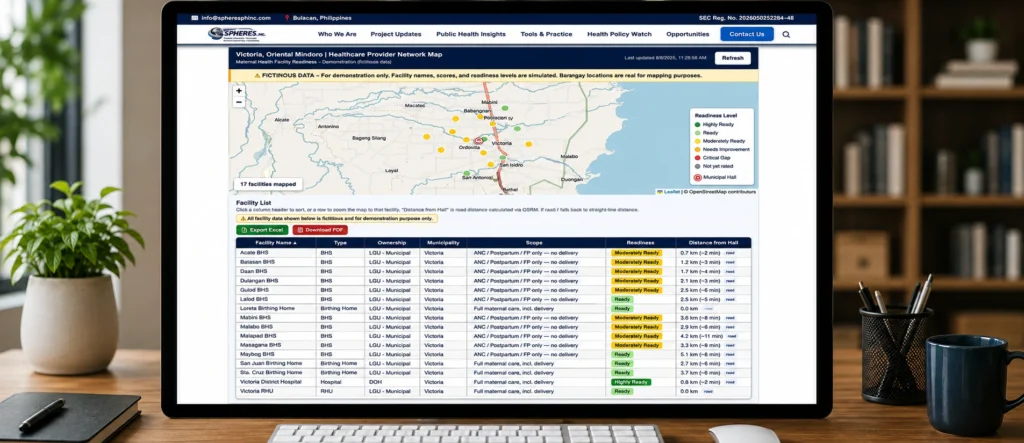
For local government units and facilities preparing for accreditation, licensing, or a readiness assessment, it is worth checking both sides separately rather than assuming one implies the other. A facility can be fully compliant on the MNDRS side, reporting every death promptly and accurately, and still have no functioning MNDSR review process at all. When that happens, deaths get counted with precision but the underlying system failures that caused them are never actually addressed.
| Resource | URL / Reference |
|---|---|
| DOH National Safe Motherhood Program | doh.gov.ph, National Safe Motherhood Program |
| UNFPA Philippines Transparency Portal | unfpa.org/data/transparency-portal/unfpa-philippines |
| WHO, Maternal and Perinatal Death Surveillance and Response | who.int, MPDSR overview |
| PRC Continuing Professional Development listing, MNDRS training | cpdas.prc.gov.ph |
Need Help With Facility Readiness or Death Review Processes?
SPHERES, Inc. works directly with local government units and health facilities on program design, facility readiness assessments, and technical assistance across the Philippines.
Get in Touch