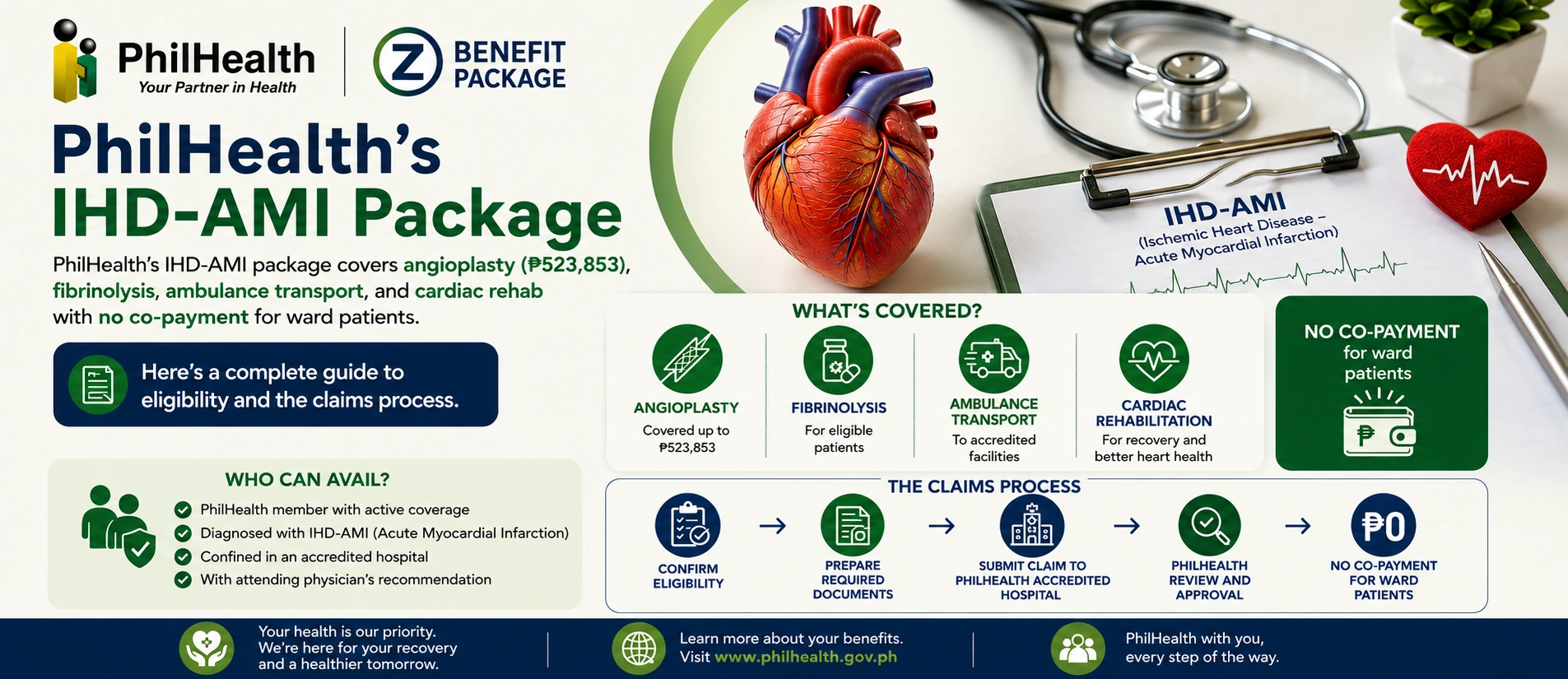
A heart attack doesn’t send an invitation. It arrives suddenly, and for most Filipino families, the first fear is whether they can afford the life‑saving treatment that follows. PhilHealth’s new Benefits Package for Ischemic Heart Disease – Acute Myocardial Infarction (IHD‑AMI), laid out in PhilHealth Circular No. 2024‑0032 and further refined by Advisory No. 2025‑0058, changes the answer. It covers not just the angioplasty or clot‑busting drugs, but the entire journey — from the ambulance ride to cardiac rehabilitation — at rates that finally reflect the real cost of saving a heart. And for ward patients, there is no co‑payment.
For years, PhilHealth’s coverage for heart attacks was pinned to the old All Case Rates system: a flat ₱30,300 for angioplasty or fibrinolysis, an amount that covered a fraction of the real expense. The new IHD‑AMI package is part of the shift to Diagnosis‑Related Groups (DRGs) mandated by the Universal Health Care Act. It bundles everything — emergency transport, the procedure itself, professional fees, medicines, supplies, and post‑hospital rehab — into a single, evidence‑based rate. The increase is dramatic, and the financial protection is real.
The IHD‑AMI benefit is actually a family of four interconnected packages, plus a special provision for lower‑level facilities:
| Package Code | Service | Rate (PHP) |
|---|---|---|
| IHD‑AMI‑A | Percutaneous Coronary Intervention (PCI) / Angioplasty with Stent | 523,853 |
| IHD‑AMI‑B | Fibrinolysis (clot‑dissolving treatment) | 133,500 |
| IHD‑AMI‑C | Emergency Medical Services with Coordinated Referral & Interfacility Transfer | 21,900 |
| IHD‑AMI‑D | Cardiac Rehabilitation (post‑heart attack) | 66,140 |
| — | Coronary Angiogram & Medical Management (without PCI) | Up to 197,000 (actual SOA) |
| — | Presumptive diagnosis / emergency transfer by lower‑level facility | 5,200 |
Inside those rates, the package covers the full spectrum of needed services: intensive care, specialist consultations, 12‑lead ECG, Troponin I/HS, 2D‑Echocardiography, cardiac catheterization, coronary stents and balloons, fibrinolytics like Alteplase, antiplatelets, anticoagulants, beta‑blockers, statins, and even post‑procedure rehabilitation. Nothing is left out deliberately — the cost you see is the cost the system shoulders.
No 24‑hour admission rule. Unlike some older benefit packages, a patient does not need to be admitted for at least 24 hours to qualify. The package can be claimed even if the revascularization happens within hours of arrival. This single rule change removes a dangerous incentive to delay life‑saving treatment.
All PhilHealth members — employed, voluntary, lifetime, sponsored — who have the required three months of contributions in the six‑month window before confinement are eligible. Their dependents are covered too. The package covers all types of acute myocardial infarction, both STEMI and Non‑STEMI, defined by a rise in cardiac biomarkers (troponin) with clinical evidence of ischemia.
A non‑specific or non‑diagnostic ECG does not disqualify a patient. This is crucial because a significant number of heart attacks, particularly NSTEMI, present with only mild ECG changes. The benefit follows the clinical and laboratory diagnosis, not just the tracing.
One of the most practical improvements in this circular is the emphasis on a functioning referral network. A small infirmary or primary care clinic that cannot perform PCI or give fibrinolytics is not left out. It can stabilize the patient, coordinate transfer to a capable hospital, and claim the ₱5,200 presumptive diagnosis/transfer package. Meanwhile, the receiving hospital files its own claim for the procedure.
Referrals can even happen between facilities of the same level, not just upward, to speed up access to revascularization or to cardiac rehab. The system is designed to move the patient to care, not to force a rigid hierarchy that delays treatment.
The Emergency Medical Services package (₱21,900) covers the ambulance transport with proper coordination and referral. This means even the ride that saves a life is no longer an out‑of‑pocket surprise.
For the first time, cardiac rehabilitation is embedded into the heart attack package itself, not as a separate, optional service. Under IHD‑AMI‑D, a patient is entitled to at least six (6) rehabilitation sessions on different dates, which can begin while still admitted and continue on an outpatient basis. The package reimburses up to ₱66,140.
What if the hospital has no dedicated cardiac rehab specialist? The circular explicitly allows a cardiologist working with a physiatrist to deliver the service. This practical flexibility means geography or specialist shortages cannot block a patient from completing rehab.
Consider a 55‑year‑old market vendor from Laguna. He feels severe chest pressure and is rushed to a small rural health unit. The staff performs an ECG, suspects a heart attack, and immediately coordinates transfer via ambulance to a Level 3 government hospital. In the cath lab, a completely blocked artery is opened with a stent. He stays four days and then begins cardiac rehab sessions that start in the hospital and continue twice a week after discharge.
Without the IHD‑AMI package, his family might have faced a bill exceeding ₱500,000. With it, because he is a sponsored member in a ward bed, he pays zero. The referring health unit claims ₱5,200, the ambulance service claims ₱21,900, the hospital claims ₱523,853 for the PCI, and later the rehab center claims ₱66,140. The system covers it all.
Under the previous All Case Rate of ₱30,300 for PCI, patients covered only about 6% of the procedure cost on average. The new rate of ₱523,853 flips that — for ward patients, it covers 100% with no balance billing. This is the single largest increase in financial protection for acute cardiac care in PhilHealth’s history.
Hospitals file claims within 60 calendar days from discharge. Members do not file directly. The mandatory attachments depend on the package:
Statutory discounts — such as those for senior citizens and persons with disabilities — must be deducted first from the total bill before private health insurance or HMOs are applied. Miscalculating this order can lead to denied claims or unexpected balances.
If a patient dies within two days of admission, the hospital can still claim based on the actual statement of account up to the full package cap (₱523,853 for PCI), with the same no‑balance‑billing protection for ward patients. The package does not vanish because the outcome was tragic; the system still bears the cost.
The IHD‑AMI package is for the emergency management of a heart attack. It is not the same as the Z Benefit for Coronary Artery Bypass Graft (CABG), which covers open‑heart surgery for severe multi‑vessel disease that cannot be treated with stents alone. CABG is a scheduled, separate package with rates of ₱660,000 to ₱960,000. Together, these two benefits create a continuum: acute heart attack treatment through the IHD‑AMI DRG package, and if surgery is later needed, the CABG Z Benefit. No single episode of illness should break a family financially — and the system is finally being built to deliver that promise.